BYTS Interior

Interior Design Glossary — 50 Terms Every Kerala Homeowner Should Know

Interior Design Glossary — 50 Terms Every Kerala Homeowner Should Know — BYTS Interior Palakkad Kerala

Interior design conversations are full of terms that are obvious to designers but confusing to first-time homeowners. This glossary explains 50 of the most common terms in plain English — so you can read quotations confidently, understand every conversation with your designer, and make informed decisions.

Key takeaway

The three terms most misunderstood by Kerala homeowners: BWR versus commercial-grade plywood (the humidity performance gap is critical), carcass versus shutter (the box versus the door), and per-sq-ft rate (which area it actually applies to — always ask).

Material Terms

Term What it means Why it matters in Kerala
BWR Plywood Boiling Water Resistant plywood — IS:303 grade, phenol-formaldehyde bonded The correct material for all Kerala kitchen and wardrobe carcasses — moisture-proof
MR Plywood Moisture Resistant plywood — lower grade, urea-formaldehyde bonded Not suitable for Kerala kitchen carcasses — will swell in monsoon conditions
HDHMR High Density High Moisture Resistant board — engineered wood panel Alternative to plywood — acceptable with all edges fully sealed
MDF Medium Density Fibreboard — wood fibre and resin panel Good for door profiles in dry rooms — avoid near moisture in Kerala
Laminate (HPL) High Pressure Laminate — decorative surface bonded to core material Good shutter surface in dry areas — edges must be sealed in Kerala
Membrane / PVC foil Vacuum-pressed PVC film on MDF profile Best all-round shutter surface for Kerala kitchens — seamless, moisture-resistant
Acrylic shutter Solid acrylic panel bonded to substrate Premium, very durable, fully moisture-resistant — shows fingerprints on gloss
Veneer Thin real wood slice bonded to a substrate Natural wood appearance — requires sealing in Kerala humidity

Structural and Construction Terms

Term What it means
Carcass The box body of a cabinet unit — the structural shell, not the door
Shutter The door or drawer front of a cabinet unit — the visible face
Edge banding PVC or ABS strip applied to all cut edges of panels — seals exposed wood edges
Multi-boring Factory drilling of hinge holes and fixing holes at precise positions
CNC cutting Computer Numerical Control panel cutting — precision under 1mm tolerance
False ceiling Secondary ceiling installed below the structural slab — for lighting and aesthetics
GI frame Galvanised iron frame — the structural skeleton of a false ceiling
Gypsum board The panel material used on false ceilings and wall cladding — damaged by moisture
PVC ceiling panel Waterproof ceiling panel — appropriate for bathrooms and utility areas
Cove Concave recessed ledge at wall-ceiling junction — used for concealed LED lighting

Design and Layout Terms

Term What it means
Work triangle The three-point triangle between hob, sink, and refrigerator — determines kitchen efficiency
L-shape kitchen Kitchen with cabinets on two walls at a right angle
Parallel kitchen Kitchen with two facing rows of cabinets — also called galley kitchen
U-shape kitchen Kitchen with cabinets on three walls — maximum storage configuration
Island A free-standing central counter unit — requires substantial open floor space
Peninsula A counter attached to one wall that projects into the open area — alternative to an island
Soft-close Hinge or channel mechanism that slows and silences closing action
Full-extension channel Drawer slide that allows complete access to the full drawer depth
Magic corner Corner cabinet fitting that brings stored items forward for easy access
Larder unit Tall full-height storage cabinet — for pantry and appliance storage

Lighting Terms

Term What it means
Cove lighting Concealed LED strips in a cove that cast indirect light on the ceiling
Recessed light Light fixture installed flush with the ceiling surface — also called downlight
Colour temperature Warmth or coolness of light — 2700K warm white, 4000K neutral, 6500K cool white
Lux Unit of illuminance — how much light falls on a surface. Kitchen work surfaces need 300 to 500 lux.
CRI Colour Rendering Index — how accurately a light source renders colours. 90+ CRI recommended for kitchens.
Pendant light Hanging light fixture — decorative over dining tables and islands
Under-cabinet light LED strip mounted below wall cabinets to illuminate the countertop work surface

Contract and Process Terms

Term What it means
Itemised quotation Quotation that lists every material and component with individual prices — the only safe type
Package price Single total price for a scope without component breakdown — allows hidden substitutions
Variation order (VO) Formal document recording any change to the approved scope — must be signed before execution
BOQ Bill of Quantities — detailed list of every item with quantity and unit rate
Snag list List of items to be completed or corrected before handover — must be cleared before sign-off
Per sq ft rate Price per square foot — always clarify which area this applies to (shutter area, carcass area, or running foot)
Civil work Tile laying, plastering, painting, electrical, and plumbing — often excluded from interior quotations
Site readiness State of the construction site when interior installation can begin — all civil work completed
⚠️ Warning: Never accept a quotation that uses only package pricing without an itemised breakdown. Package prices – complete kitchen for X rupees – allow material substitution without your knowledge. An itemised quotation with every material specified by grade is the only contract that protects you.

Frequently asked questions

Q: What is the difference between a carcass and a shutter?
A: The carcass is the box body of a cabinet — the structural shell that holds the shelves and contains the storage space. The shutter is the door that you open and close to access the carcass. A carcass built from IS:303 BWR plywood determines how long the kitchen lasts. The shutter determines how the kitchen looks. Both matter — but the carcass matters more in Kerala.
Q: What does per sq ft rate mean in an interior quotation?
A: Per square foot rate is the price per unit area of the interior element being quoted. The confusion is that different firms measure different areas — some quote per sq ft of shutter area (the visible door surface), some quote per sq ft of carcass area (the total cabinet area including interior), and some quote per running foot of cabinet length. Always ask specifically: “Per sq ft of what area?” before comparing quotations.
Q: What does civil work mean and why is it often excluded from interior quotations?
A: Civil work refers to the construction trades that prepare the space for interior installation: tile laying, plastering and painting, creation of electrical points, and plumbing modifications. Interior firms typically quote only for the furniture and carpentry they supply and install — not for the civil preparation work. For a 3BHK in Kerala, excluded civil work can add significantly to the total project cost.
Q: What is the IS:303 standard?
A: IS:303 is the Bureau of Indian Standards certification for plywood used in furniture and interior applications. The IS:303 BWR (Boiling Water Resistant) grade is the highest performance level within this standard — it is required to withstand 8 hours of boiling water immersion without delaminating. This is the standard you should specify for all kitchen and wardrobe carcasses in Kerala.

Ready to transform your home?

Book a FREE site visit — Palakkad, Thrissur, Kozhikode & Coimbatore. Our senior team visits at no charge.

Book free consultation →
WhatsApp us

🏠

Design Team, BYTS Interior

10–20 years of combined interior design experience across Kerala and Tamil Nadu. All projects designed and manufactured at our Palakkad factory. Serving Palakkad, Thrissur, Kozhikode, Kochi & Coimbatore.

Disclaimer
The information shared in this article is based on BYTS Interior’s industry experience, project observations, and general interior design practices commonly followed in Kerala and South India. Project costs, timelines, material performance, approvals, and technical requirements may vary depending on site conditions, client preferences, market fluctuations, building structure, and local authority regulations. Readers are advised to consult qualified professionals before making financial, structural, or technical decisions based on this content.

L-Shape vs U-Shape vs Parallel Kitchen — Which Layout for Your Kerala Home?

L-Shape vs U-Shape vs Parallel Kitchen — Which Layout for Your Kerala Home? — BYTS Interior Palakkad Kerala

The layout of your modular kitchen determines how efficiently you cook, how much storage you have, and how well the kitchen fits your available space. For Kerala homes ranging from 80 sq ft apartment kitchens to 200 sq ft villa kitchens, the right layout choice makes a significant practical difference.

Key takeaway

L-shape is the most popular in Kerala apartments. Parallel suits independent houses with long narrow kitchens. U-shape delivers the most storage for larger dedicated kitchen rooms. But layout matters less than storage planning within it — a well-planned L-shape outperforms a poorly planned U-shape.

How Kerala Home Sizes Shape the Layout Decision

Kerala apartment kitchens are typically 80 to 120 sq ft. Independent house kitchens range from 100 to 160 sq ft. Villa kitchens range from 120 to 250 sq ft. The layout must fit the physical room while leaving enough clear floor space for comfortable cooking movement — minimum 900mm between any two facing counters.

Kitchen Layout Comparison

Layout Best Kerala use Room size needed Counter length Storage potential Our recommendation
L-shape Apartments, mid-size homes 80 sq ft minimum Good Good Most popular — best for Kerala apartments
Parallel (galley) Long narrow kitchens 70 sq ft (long room) Excellent Very good Best counter length for narrow rooms
U-shape Villas, large apartments 120 sq ft minimum Excellent Excellent Maximum storage — needs space to work
Island Open-plan premium villas 200+ sq ft combined Maximum Maximum Premium only — needs genuinely large space
Single wall Studio or compact utility 60 sq ft minimum Limited Limited Last resort — for very small spaces only

L-Shape Kitchen — the Kerala Favourite

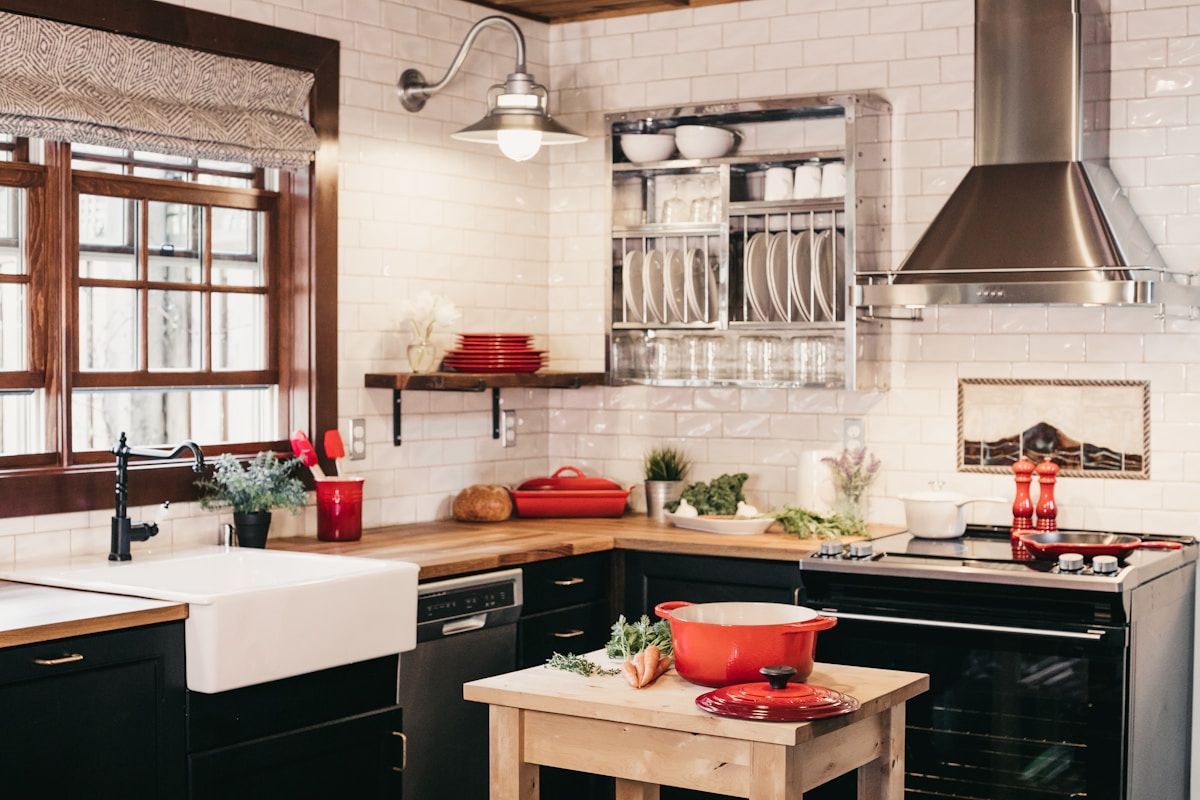
The L-shape uses two walls at a right angle. It creates a natural work triangle between the hob, sink, and refrigerator. It leaves central floor space open — which matters in Kerala homes where the kitchen often connects to a dining area or utility room. The L-shape accommodates a chimney cleanly above the hob on one of the two walls and allows the sink to be positioned near a window on the other wall.

💡 Expert tip: The most common L-shape mistake in Kerala kitchens: placing the refrigerator at the inner corner of the L, where it blocks the flow between the two counter runs. Always position the refrigerator at one of the outer ends of the L — at either extremity of the longer counter run.

Parallel (Galley) Kitchen — Best Use of a Narrow Room

Two parallel counters facing each other. This layout maximises counter length in a long narrow room. The critical dimension is the corridor between the two counters — minimum 900mm clear (ideally 1050mm). Anything narrower and two people cannot work in the kitchen simultaneously, and appliance doors become obstacles.

U-Shape Kitchen — Maximum Storage

Three walls of cabinets and counter. The U-shape gives the most storage of any configuration and the most flexible work zone arrangement. It works well in dedicated kitchen rooms of 120 sq ft and above. Corner units are critical in a U-shape kitchen — poorly designed corners waste the most accessible storage space. Specify pull-out corner units or carousel units for all corner positions.

⚠️ Warning: Never plan a U-shape kitchen in a room less than 120 sq ft. The three walls of cabinetry in a small room create a cramped cooking environment with tight corners and limited movement space. An L-shape in a smaller room is always preferable to a forced U-shape.

Storage Accessories That Transform Any Layout

  • Pull-out base units — convert dead base cabinet space into fully accessible storage
  • Magic corner units — make the most of both walls at the L-corner
  • Tall larder units — floor-to-ceiling storage columns for groceries, appliances, and cleaning supplies
  • Under-sink organiser pull-outs — doubles the usable space in the base unit below the sink
  • Cutlery inserts and drawer dividers — keeps every drawer organised without additional depth

Frequently asked questions

Q: What is the most popular kitchen layout in Kerala apartments?
A: L-shape is by far the most popular layout in Kerala apartments — especially in Palakkad, Thrissur, and Kochi. It works in rooms from 80 sq ft upward, accommodates the standard Kerala chimney position cleanly, and leaves sufficient floor space for kitchen movement.
Q: How much floor space do I need between kitchen counters?
A: Minimum 900mm (3 feet) between any two facing counters — in a parallel kitchen or between the island and the main counter. For comfortable two-person cooking, 1050mm is the preferred gap. For kitchens where wheelchair access is needed, 1200mm minimum.
Q: Can I have an island kitchen in a Kerala apartment?
A: Island kitchens in apartments are rare because they require the kitchen to flow open-plan into the living area with a combined space of at least 200 sq ft. Standard Kerala apartment kitchens with a closed kitchen room are not suitable for an island. A peninsula (a counter attached to one wall that projects into the space) is a practical alternative.
Q: Which layout gives the most storage for a Kerala home?
A: U-shape gives the most storage of any standard layout, followed closely by parallel, then L-shape. However, the storage accessories you specify within the layout often matter more than the layout itself. A well-accessorised L-shape with pull-outs and tall larder units can match a basic U-shape in usable storage.

Ready to transform your home?

Book a FREE site visit — Palakkad, Thrissur, Kozhikode & Coimbatore. Our senior team visits at no charge.

Book free consultation →
WhatsApp us

🏠

Design Team, BYTS Interior

10–20 years of combined interior design experience across Kerala and Tamil Nadu. All projects designed and manufactured at our Palakkad factory. Serving Palakkad, Thrissur, Kozhikode, Kochi & Coimbatore.

Disclaimer
The information shared in this article is based on BYTS Interior’s industry experience, project observations, and general interior design practices commonly followed in Kerala and South India. Project costs, timelines, material performance, approvals, and technical requirements may vary depending on site conditions, client preferences, market fluctuations, building structure, and local authority regulations. Readers are advised to consult qualified professionals before making financial, structural, or technical decisions based on this content.
Vastu Kitchen Design in Kerala — What Works in a Modular Layout

Vastu Kitchen Design in Kerala — What Works in a Modular Layout — BYTS Interior Palakkad Kerala

Vastu Shastra is a meaningful consideration for many Kerala homeowners — and the good news is that a modular kitchen can be fully vastu-compliant without compromising modern design or daily functionality. Our Palakkad designers include vastu-conscious layout planning for all Kerala clients at no additional charge.

Key takeaway

Most vastu requirements for a kitchen — cooking direction, sink placement, refrigerator position, colour choices — are fully achievable within standard L-shape, U-shape, and parallel modular layouts. Vastu and modern modular design are not in conflict.

Why Vastu and Modular Kitchens Work Well Together

Traditional vastu guidance for kitchens focuses on zone placement (where the kitchen is in the home), orientation (which direction the cook faces), and element positions (where fire, water, and earth elements are placed). All of these are layout considerations — and modular kitchens are precisely about optimising layout. A skilled modular kitchen designer who understands vastu principles can incorporate both seamlessly.

Key Vastu Principles for Kerala Kitchens

Element Vastu Principle How We Apply It
Kitchen location South-east corner of the home is ideal Discussed at initial site visit — worked into floor plan where possible
Cooking direction Cook should face east while cooking Hob placed on east-facing wall where possible in L-shape and parallel layouts
Sink placement North-east corner preferred for water element Achievable in most L-shape and parallel layouts
Refrigerator position South-west or west — earth element Standard placement in most modular kitchen configurations
Microwave and appliances South-east — fire element zone Positioned on the south-east counter section
Storage West and south walls for heavy storage Upper cabinets on west and south walls
Colours Warm tones — yellow, cream, orange, white — preferred Applied through shutter colour and wall paint selection
Clutter No clutter above cooking platform Open shelf design above hob avoided in vastu-conscious layouts

When Apartment Configurations Limit Ideal Vastu Placement

Many apartment configurations in Palakkad, Thrissur, and Kochi have kitchens in fixed locations that may not align with the ideal vastu corner. In these cases, our designers focus on the internal vastu adjustments — cooking direction, sink quadrant, colour choices, and appliance placement — which provide meaningful vastu alignment within the available space.

💡 Expert tip: Vastu remedies within the kitchen can compensate significantly for a non-ideal kitchen location in the overall home. Colour, cooking direction, and element placement are within your control regardless of where the kitchen is positioned.

Colours That Work — Vastu and Design Together

  • Yellow — the most vastu-auspicious kitchen colour, and a warm, functional choice for Kerala homes
  • Cream and off-white — clean, practical, and vastu-neutral — the most popular shutter choice in our Kerala projects
  • Orange tones — warm and positive, works well as an accent colour for kitchen walls
  • Green — acceptable for upper units or accents but avoid dark green on lower cabinets in vastu guidance
  • Red and dark tones — generally avoided in vastu-conscious Kerala kitchen design

Pooja Room Vastu — the Connection to Kitchen Design

In many Kerala homes, the pooja room or altar corner is adjacent to or visible from the kitchen. Our designers consider the relationship between the kitchen and pooja space when planning the overall layout — particularly the cooking orientation and the visual line between the two spaces.

⚠️ Warning: Avoid positioning the cooking platform directly under a beam or in a corner where the cook faces a wall with no window or light. Both vastu guidance and practical cooking ergonomics agree on this point – the cooking position should feel open and comfortable, not cramped.

Frequently asked questions

Q: Can a modular kitchen be fully vastu-compliant?
A: Yes. The key vastu elements — cooking direction, sink placement, refrigerator and appliance positions, and colour choices — are all achievable within standard modular kitchen layouts. Our Palakkad designers plan these as part of the standard design process for all Kerala clients.
Q: Does BYTS Interior charge extra for vastu-conscious kitchen design?
A: No. Vastu-conscious layout planning is included in our standard design process for all Kerala and Coimbatore clients. We do not treat vastu as a premium service.
Q: What if my apartment kitchen cannot be in the vastu-ideal south-east corner?
A: This is very common in apartment configurations. We focus on internal vastu adjustments — cooking orientation, sink quadrant, colour, and appliance placement — which provide meaningful vastu alignment regardless of the kitchen’s fixed position in the building.
Q: Which modular kitchen layout is most vastu-friendly?
A: The L-shape layout is generally the most flexible for vastu compliance because it allows the cooking platform and sink to be positioned on different walls, making east-facing hob and north-east sink placement achievable in most configurations.

Ready to transform your home?

Book a FREE site visit — Palakkad, Thrissur, Kozhikode & Coimbatore. Our senior team visits at no charge.

Book free consultation →
WhatsApp us

🏠

Design Team, BYTS Interior

10–20 years of combined interior design experience across Kerala and Tamil Nadu. All projects designed and manufactured at our Palakkad factory. Serving Palakkad, Thrissur, Kozhikode, Kochi & Coimbatore.

Disclaimer
The information shared in this article is based on BYTS Interior’s industry experience, project observations, and general interior design practices commonly followed in Kerala and South India. Project costs, timelines, material performance, approvals, and technical requirements may vary depending on site conditions, client preferences, market fluctuations, building structure, and local authority regulations. Readers are advised to consult qualified professionals before making financial, structural, or technical decisions based on this content.

Modular Kitchen in Kerala: The Complete Homeowner Guide (2025)

Modular Kitchen in Kerala: The Complete Homeowner Guide (2025) — BYTS Interior Palakkad Kerala

If you are building or renovating a home in Kerala and thinking about your kitchen, this guide gives you everything you need — layouts that work best in Kerala homes, materials that survive the monsoon, mistakes that lead to expensive regrets, and the questions to ask any designer before you sign anything.

Key takeaway

The single most important material decision in a Kerala kitchen is plywood grade. BWR (IS:303) plywood is moisture-proof. MR plywood is not. This one choice determines whether your kitchen lasts 2 years or 12.

What Is a Modular Kitchen?

A modular kitchen is built from pre-manufactured cabinet units — modules — produced at a factory and assembled on-site. Each module is a box (carcass) of plywood, with a shutter (door) and hardware inside. Compare this to a traditional on-site carpenter kitchen where everything is built in your home over several weeks.

📌 Key insight: Factory CNC-cut panels have tolerances under 1mm. Hand-cut carpentry typically has tolerances of 3 – 8mm. That gap shows up in every door alignment, drawer slide and shelf level across years of daily use.

Kitchen Layouts for Kerala Homes

Layout Best for Kerala use Minimum space Common in
L-shape Standard apartments and mid-size homes 80 sq ft Palakkad, Thrissur, Kochi apartments
Parallel Long narrow kitchens in independent houses 70 sq ft (long) Traditional Kerala homes
U-shape Larger homes with dedicated kitchen rooms 120 sq ft Kerala villas and large apartments
Island Open-plan premium homes only 200 sq ft combined Premium villas in Palakkad and Kochi

Carcass Material — The Most Important Decision

Material IS Standard Kerala suitability BYTS recommendation
BWR Plywood IS:303 Excellent — phenol-bonded, moisture-proof Standard in every BYTS kitchen
MR Plywood IS:303 (lower grade) Poor — not suitable for Kerala kitchens Not recommended
HDHMR Board None Good with all edges fully sealed Acceptable alternative
MDF None Poor — swells rapidly in humidity Avoid for carcasses in Kerala
Particle Board None Very poor — fails within 2 monsoon seasons Never use in Kerala kitchens
⚠️ Warning: The most expensive mistake Kerala homeowners make: choosing lower-grade plywood to save cost on the carcass. A beautiful shutter on a poor-quality carcass will look good for one monsoon season and then begin to fail.

Shutter Material Options

  • Membrane (PVC foil) — most popular in Kerala. Seamless, moisture-resistant, wide colour range. Best value for most homeowners.
  • Acrylic shutters — high-gloss, scratch-resistant, premium choice. Fingerprints show on gloss surfaces.
  • Laminate shutters — entry-level, good in dry areas with fully sealed edges.
  • PU paint on MDF — bespoke look, requires good ventilation, most premium option.
💡 Expert tip: Hettich and Hafele are the most trusted hardware brands in the Kerala market. Powder-coated hinges and channels outlast chrome fittings by 4–6 times in Kerala humidity. BYTS Interior specifies Hettich as standard hardware for all kitchen projects.

The BYTS Interior Kitchen Installation Process

  1. Site measurement — precise dimensions, photographs, electrical and plumbing positions (45–60 minutes)
  2. 3D design and proposal — photorealistic renders, itemised quotation, unlimited revisions at no cost
  3. Material approval — confirm plywood, shutters, hardware and countertop in writing before production
  4. Factory production — CNC cutting, edge banding, boring at our Palakkad factory (12–18 days)
  5. Site preparation — electrician positions sockets correctly, civil work completed
  6. Delivery and installation — modules fitted by our own team (2–3 days on-site)
  7. Handover — walkthrough of every fitting, care guide, 1-year written service warranty

Frequently asked questions

Q: How long does a modular kitchen in Kerala last?
A: A properly installed kitchen using IS:303 BWR plywood, quality shutters, and branded hardware should last 12–15 years in Kerala conditions. Hardware may need attention at the 8–10 year mark.
Q: What is the best plywood grade for a Kerala kitchen?
A: IS:303 BWR (Boiling Water Resistant) plywood. It uses phenol-formaldehyde resin between layers — moisture-proof. MR plywood uses a weaker resin and is not sufficient for Kerala kitchen conditions.
Q: Can I order just a kitchen without a full home interior project?
A: Yes — kitchen-only projects are our most common single-room service. We provide a standalone quote based on your dimensions and material preferences.
Q: Does BYTS Interior serve Coimbatore?
A: Yes. Our Palakkad factory is approximately 60 km from Coimbatore via NH544. We serve Coimbatore clients with the same production and installation timeline as our Kerala clients.

Ready to transform your home?

Book a FREE site visit — Palakkad, Thrissur, Kozhikode & Coimbatore. Our senior team visits at no charge.

Book free consultation →
WhatsApp us

🏠

Design Team, BYTS Interior

10–20 years of combined interior design experience across Kerala and Tamil Nadu. All projects designed and manufactured at our Palakkad factory. Serving Palakkad, Thrissur, Kozhikode, Kochi & Coimbatore.

Disclaimer
The information shared in this article is based on BYTS Interior’s industry experience, project observations, and general interior design practices commonly followed in Kerala and South India. Project costs, timelines, material performance, approvals, and technical requirements may vary depending on site conditions, client preferences, market fluctuations, building structure, and local authority regulations. Readers are advised to consult qualified professionals before making financial, structural, or technical decisions based on this content.

Villa Interior Design in Kerala — Investment Levels and What to Expect

Villa Interior Design in Kerala — Investment Levels and What to Expect — BYTS Interior Palakkad Kerala

Villa interior design in Kerala spans a wide range — from practical standard-tier homes to fully bespoke luxury projects. Understanding what each investment level delivers helps you plan a villa interior that is appropriate for your family and your budget without unrealistic expectations on either side.

Key takeaway

A villa interior must create genuine zones — formal drawing room, family living, study, dedicated dining, and outdoor spaces. Large rooms in villas need thoughtful furniture scale and layered lighting to feel complete. The most common villa interior mistake is under-furnishing large rooms.

What Makes a Villa Interior Different From an Apartment

  • Scale — villa rooms are typically 30 to 50% larger than apartment equivalents. Standard apartment-scale furniture looks undersized and the room feels empty.
  • Multiple living zones — a villa typically has a formal drawing room, a family living area, and sometimes a study or media room. Each zone needs its own design identity.
  • Ceiling height — Kerala villas typically have 10 to 14 foot ceilings. This changes the proportions of false ceilings, curtains, wardrobes, and all vertical elements.
  • Outdoor integration — sit-outs, courtyards, and garden areas are part of the villa interior brief. Outdoor furniture, boundary treatment, and transition zones need design attention.
  • Staff quarters and utility areas — larger villas include staff rooms, utility areas, and garages that need functional interior treatment.

Villa Interior Investment Tiers

Tier What it includes Material approach Who it suits
Standard Modular kitchen, wardrobes in all bedrooms, TV units, basic false ceiling IS:303 BWR plywood, membrane shutters, certified hardware Practical first villa — complete and functional
Premium Full above scope plus designer false ceilings, feature walls, custom furniture, layered lighting Same carcass standard, acrylic/PU shutters, imported accessories Upgrade villa where aesthetics matter significantly
Luxury Bespoke everything — custom millwork, imported stone, designer lighting, landscaping coordination Fully custom, no catalogue selections, architect-led design Prestige residence or investment property

Kerala Villa Interior — Room-by-Room Priority

Room Villa-specific consideration Priority
Formal drawing room Scale of furniture, ceiling height proportion, formal lighting High — first impression room
Family living Comfortable, TV-oriented, casual seating, good ventilation High — most used daily
Modular kitchen Full scope — larger villa kitchens often have island or U-shape Highest — same logic as any Kerala home
Master bedroom suite Walk-in wardrobe, attached bathroom, sit-out access High — primary private space
Guest bedrooms Comfortable and complete — guests judge the villa by the guest room Medium-high
Study or home office Acoustic separation from main areas, good desk lighting, AV Medium
Sit-out and courtyard Weather-resistant furniture, evening lighting, plant integration Medium
Utility and service areas Durable and easy-clean — functional only Low
💡 Expert tip: In a Kerala villa, invest significantly in the formal drawing room ceiling design. A well-designed drawing room false ceiling with cove lighting, chandeliers, and correct proportions is the single element most noticed and most commented on by guests. This room creates the first impression of the entire villa.

Outdoor Spaces in Kerala Villas

The sit-out (verandah) and any courtyard or garden area are genuinely part of the villa interior brief. Weather-resistant outdoor furniture, evening lighting on the sit-out, and a transition zone between indoors and outdoors that handles Kerala’s monsoon (with a covered overhang and drainage) make a significant difference to how the villa feels and functions year-round.

⚠️ Warning: Avoid using indoor furniture on uncovered outdoor sit-outs in Kerala. Standard indoor fabric and frame furniture deteriorates rapidly in monsoon conditions. Specify teak or powder-coated aluminium frames with solution-dyed acrylic fabric for any furniture exposed to monsoon rain.

Frequently asked questions

Q: How long does a complete villa interior take in Kerala?
A: A complete villa interior — all rooms, full scope — takes 75 to 100 days from design approval to handover. Larger villas or fully custom luxury projects take proportionally longer.
Q: Does BYTS Interior do villa projects outside Palakkad?
A: Yes. We serve villa projects across Palakkad, Thrissur, Kozhikode, Kochi, Malappuram, and Coimbatore. Our factory in Palakkad supplies all modular carpentry elements, and our installation team travels to the project location.
Q: What is the minimum size for a formal drawing room in a Kerala villa?
A: A formal drawing room in a Kerala villa should be at least 280 sq ft to accommodate the scale of furniture and ceiling design that the space warrants. Smaller spaces are better treated as a combined family living room rather than a formal drawing room.
Q: Can BYTS Interior coordinate with my architect on a villa project?
A: Yes. For villa projects, we coordinate our interior scope directly with the project architect. We provide our material specifications, fixing requirements, and installation sequencing to the architect to ensure our work integrates correctly with the civil and structural work.

Ready to transform your home?

Book a FREE site visit — Palakkad, Thrissur, Kozhikode & Coimbatore. Our senior team visits at no charge.

Book free consultation →
WhatsApp us

🏠

Design Team, BYTS Interior

10–20 years of combined interior design experience across Kerala and Tamil Nadu. All projects designed and manufactured at our Palakkad factory. Serving Palakkad, Thrissur, Kozhikode, Kochi & Coimbatore.

Disclaimer
The information shared in this article is based on BYTS Interior’s industry experience, project observations, and general interior design practices commonly followed in Kerala and South India. Project costs, timelines, material performance, approvals, and technical requirements may vary depending on site conditions, client preferences, market fluctuations, building structure, and local authority regulations. Readers are advised to consult qualified professionals before making financial, structural, or technical decisions based on this content.
Interior Design for Small Apartments in Kerala — Space-Saving Ideas That Work

Interior Design for Small Apartments in Kerala — Space-Saving Ideas That Work — BYTS Interior Palakkad Kerala

A small apartment in Kerala — a 1BHK of 450 to 600 sq ft or a compact 2BHK of 650 to 800 sq ft — can feel significantly larger than its physical dimensions if designed thoughtfully. The difference is almost entirely about storage efficiency and the relationship between furniture scale and room proportions.

Key takeaway

The single most impactful change in a small Kerala apartment is floor-to-ceiling storage. A floor-to-ceiling wardrobe provides 30% more storage than a standard height unit using the same floor footprint — and the vertical emphasis makes the ceiling feel higher, which makes the room feel larger.

Why Small Apartments in Kerala Need Specific Design Thinking

Small apartment design in Kerala faces a specific challenge: the same furniture catalogue and design choices that work in larger apartments are applied regardless of room size. A sofa that is proportionate in a 350 sq ft living room looks enormous in a 180 sq ft living room. The storage system designed for a 150 sq ft bedroom bedroom overwhelms a 110 sq ft bedroom.

5 Principles That Make Small Apartments Feel Larger

  1. Floor-to-ceiling storage everywhere — wardrobes, kitchen cabinets, TV units, and living room storage all extended to ceiling height. The vertical emphasis raises the perceived ceiling height and removes the visual clutter of the space above standard-height furniture.
  2. Light, wall colours — warm white or cream on walls. Colour is not the enemy of small spaces but dark or complex patterns reduce perceived volume. Save colour for one accent wall or for soft furnishings.
  3. Multi-functional furniture — beds with hydraulic storage drawers below, dining tables that fold against the wall, sofas with storage underneath, ottomans that double as coffee tables.
  4. Consistent flooring throughout — using the same flooring material across the entire apartment (kitchen, living, bedroom) without transition strips creates an unbroken visual field that reads as a single larger space.
  5. Mirrors used deliberately — a full-height mirror panel on one wall of a living room or bedroom visually doubles the perceived depth of the room. Position opposite a window for maximum daylight reflection.

Kitchen Design for Small Kerala Apartments

The kitchen is where small apartment design has the most impact. A compact L-shape or parallel kitchen with floor-to-ceiling upper cabinets and a properly planned work triangle can provide a complete, functional kitchen in as little as 60 to 80 sq ft.

  • Use the full height — upper cabinets should extend to the ceiling. The cabinet above the refrigerator is premium storage space that most compact kitchen designs leave as empty space.
  • Integrate the chimney into the upper cabinet design — a chimney that is flanked by upper cabinets on both sides is visually cleaner and creates more storage than one that stands alone.
  • Avoid a dining table in the kitchen if the kitchen opens to the living area — a breakfast counter built into the kitchen design at standing or bar stool height serves the same function in a fraction of the floor space.
  • Choose a compact 4-burner hob or a 3-burner hob if cooking for fewer than 4 people — the hob is the largest counter-space consumer in a small kitchen and a 3-burner option is fully functional for most Kerala households.
Space-saving choice Standard approach Space saved
Floor-to-ceiling wardrobe Standard height wardrobe 30% more storage per meter of floor length
Hydraulic storage bed Platform bed without storage Full under-bed volume as accessible storage
Fold-flat dining table 4-seater dining table always extended Up to 8 sq ft of floor space recovered when folded
Wall-mounted study desk Free-standing study desk Full floor footprint of desk recovered when folded up
Integrated kitchen chimney Free-standing range hood Cabinet space above and around hob recovered
💡 Expert tip: For small Kerala bedrooms under 120 sq ft, avoid placing the bed in the centre of the room. Place the bed against the longest wall — this leaves clear floor space on both sides for movement and makes the room feel significantly more spacious than a centred placement.

Lighting for Small Kerala Apartments

Good lighting makes a small apartment feel larger. The key is layering — ambient light from the ceiling, task light at work surfaces, and accent light that creates depth. A single central overhead light flattens a small room and makes it feel smaller. Three to four light sources at different heights create perceived depth.

⚠️ Warning: Never use dark wall colours in a small Kerala apartment to create a ‘cosy’ feel — it will make the space feel smaller and darker, especially in Kerala’s diffused natural light. Stick to warm white or cream on all walls and save colour for one accent element or soft furnishings.

Frequently asked questions

Q: What is the smallest space a modular kitchen can work in?
A: A functional modular kitchen can be installed in as little as 60 sq ft using a single-wall or compact parallel layout. The minimum for a comfortable two-person cooking kitchen is 80 sq ft with an L-shape or parallel layout.
Q: Can floor-to-ceiling wardrobes be installed in Kerala apartments?
A: Yes. Floor-to-ceiling wardrobes are completely practical in Kerala apartments and are installed in our projects regularly. They require the ceiling to be flat (or the wardrobe to accommodate a false ceiling profile) and a site measurement that accounts for any beam or duct in the ceiling zone. BYTS Interior takes precise measurements to ensure the wardrobe fits correctly to the full height.
Q: How do I make a small Kerala living room feel bigger?
A: Four changes with the most impact: use warm white on all walls, keep the floor consistent throughout (same tile from the entrance to the living room), add a full-height mirror on one wall, and choose furniture that is proportionate to the room scale rather than standard apartment-sized furniture.
Q: Does BYTS Interior do small apartment projects?
A: Yes. Small apartment projects are a significant part of our residential work. We design modular kitchens, wardrobes, and storage solutions specifically optimised for compact apartment sizes across Palakkad, Thrissur, Kochi, and Coimbatore.

Ready to transform your home?

Book a FREE site visit — Palakkad, Thrissur, Kozhikode & Coimbatore. Our senior team visits at no charge.

Book free consultation →
WhatsApp us

🏠

Design Team, BYTS Interior

10–20 years of combined interior design experience across Kerala and Tamil Nadu. All projects designed and manufactured at our Palakkad factory. Serving Palakkad, Thrissur, Kozhikode, Kochi & Coimbatore.

Disclaimer
The information shared in this article is based on BYTS Interior’s industry experience, project observations, and general interior design practices commonly followed in Kerala and South India. Project costs, timelines, material performance, approvals, and technical requirements may vary depending on site conditions, client preferences, market fluctuations, building structure, and local authority regulations. Readers are advised to consult qualified professionals before making financial, structural, or technical decisions based on this content.
Villa Interior Design in Palakkad — A Complete Local Guide

Villa Interior Design in Palakkad — A Complete Local Guide — BYTS Interior Palakkad Kerala

Palakkad’s villa market has grown significantly in residential areas including Chandranagar, Kalpathy, Kalmandapam, Kallekkad, and the areas toward Chittur. BYTS Interior’s studio and factory are both based in Palakkad — giving our clients a genuine local advantage that visiting firms from Kochi or Thrissur cannot provide.

Key takeaway

Our Palakkad location means we are a resident team, not a visiting firm. Site visits happen quickly. Material queries are resolved at the factory. After-sales support is local. This is not a marketing claim — it is a structural feature of how we work.

Palakkad Villa Market — What We Are Seeing

Villa construction in Palakkad has accelerated in the last 5 years, concentrated in areas to the north and east of Palakkad town — Chandranagar, Kalpathy, Kalmandapam, and the NH544 corridor toward Coimbatore. The typical Palakkad villa project involves a 3 to 5 bedroom independent house with a dedicated kitchen, formal drawing room, family living area, dining, and outdoor sit-out.

Palakkad villas have a specific climate context that differs from coastal Kerala. The Palakkad Gap — the natural wind channel through the Western Ghats — creates a distinct micro-climate: hotter summers, stronger winds, and a different humidity pattern than Thrissur or Kozhikode. Material specifications for Palakkad villas account for this.

Popular Residential Areas — BYTS Interior Palakkad Projects

Area Character Common project type
Chandranagar Established residential area near Palakkad town Villa renovation and complete interior projects
Kalpathy Heritage town area with traditional homes and new villas Mixed traditional and contemporary interior projects
Kalmandapam Growing residential area — newer constructions New villa interior complete projects
Kallekkad and Mankara road Expanding residential zones toward NH544 New villa and independent house projects
Palakkad town centre Commercial and mixed residential Office interiors, apartment projects
NH544 corridor (toward Coimbatore) Highway-adjacent residential zones Villa and apartment projects — also serves Coimbatore clients

The Local Factory Advantage for Palakkad Villa Projects

  • Site visits on the same day or next day — not scheduled weeks ahead like visiting firms
  • Material queries resolved at the factory — you can visit and see the actual boards before production begins
  • Delivery logistics are simple — factory to Palakkad site in under 30 minutes in most cases
  • Installation team based in Palakkad — they know the local labour context and work efficiently in Palakkad homes
  • After-sales service is genuinely local — a service call reaches you the same day or next day, not next week
📌 Key insight: Palakkad homeowners who have worked with both visiting firms (from Kochi or Thrissur) and local firms consistently report that the local firm advantage shows most clearly at the problem-solving stage – when something needs attention during installation or in the first year after handover. A local team responds faster and more cost-effectively.

Palakkad Villa Interior — What We Typically See in Project Briefs

  • Kitchen: L-shape or U-shape modular kitchen with island consideration in larger villa kitchens
  • Drawing room: formal false ceiling with chandelier, feature wall, quality flooring — first impression space
  • Family living: casual and comfortable — TV wall, sofa configuration, indoor plant zone
  • Master bedroom: walk-in wardrobe preference increasingly common in Palakkad villas, attached bathroom
  • Pooja room: dedicated pooja room in most Palakkad villa briefs — vastu-conscious design standard
  • Study or home office: increasingly included as a distinct room after 2020
  • Sit-out and compound: covered sit-out treatment, compound wall design, gate and approach lighting
💡 Expert tip: For Palakkad villa projects, plan the kitchen chimney duct before the false ceiling is installed. The chimney duct routing — from the chimney position to the exterior exhaust point — needs to be coordinated with the civil contractor during construction. Retrofitting a chimney duct through a completed false ceiling is expensive and disruptive.

Our Palakkad Design Process — From First Meeting to Handover

  1. First WhatsApp or phone consultation — same day response
  2. Site visit to your Palakkad home — typically within 48 hours
  3. 3D design presentation at our Palakkad studio or your home — within 10 to 14 days of site visit
  4. Material confirmation visit to our Palakkad factory — see actual boards before production
  5. Factory production at our Palakkad facility — 18 to 28 days for a complete villa scope
  6. Delivery and installation — our own team, Palakkad-based
  7. Handover with written 1-year service warranty and local service contact
⚠️ Warning: Never start a Palakkad villa interior project without a confirmed civil-readiness checklist. The most common cause of timeline overruns in Palakkad villa projects is interior work starting before civil work is complete – creating a stop-start installation cycle that adds 3 to 6 weeks.

Frequently asked questions

Q: Does BYTS Interior have a physical office in Palakkad?
A: Yes. Our design studio and production factory are both in Palakkad. We are a resident team — not a visiting firm from another city. You can visit our studio to see completed material samples and designs, and visit our factory to see production in progress.
Q: Which areas of Palakkad does BYTS Interior serve?
A: We serve all areas of Palakkad district — Palakkad town, Chandranagar, Kalpathy, Kalmandapam, Kallekkad, Chittur, Ottapalam, Shoranur, Mannarkkad, and surrounding areas. Site visits are free throughout Palakkad district.
Q: How long does a complete Palakkad villa interior take?
A: From first meeting to handover: 75 to 100 days for a complete villa interior. For a kitchen-only or single-room project: 22 to 35 days.
Q: Can I visit the BYTS Interior factory in Palakkad?
A: Yes — and we encourage it. Seeing your specific materials at the factory before cutting begins is the most effective way to ensure the final product is exactly what you specified. We welcome factory visits from all Palakkad clients.

Ready to transform your home?

Book a FREE site visit — Palakkad, Thrissur, Kozhikode & Coimbatore. Our senior team visits at no charge.

Book free consultation →
WhatsApp us

🏠

Design Team, BYTS Interior

10–20 years of combined interior design experience across Kerala and Tamil Nadu. All projects designed and manufactured at our Palakkad factory. Serving Palakkad, Thrissur, Kozhikode, Kochi & Coimbatore.

Disclaimer
The information shared in this article is based on BYTS Interior’s industry experience, project observations, and general interior design practices commonly followed in Kerala and South India. Project costs, timelines, material performance, approvals, and technical requirements may vary depending on site conditions, client preferences, market fluctuations, building structure, and local authority regulations. Readers are advised to consult qualified professionals before making financial, structural, or technical decisions based on this content.
Interior Design Trends in Kerala for 2026 — What We Are Seeing

Interior Design Trends in Kerala for 2026 — What We Are Seeing — BYTS Interior Palakkad Kerala

These are the interior design trends we are observing directly in our own completed projects across Palakkad, Thrissur, Kozhikode, and Coimbatore — not borrowed from Delhi or international publications that describe different climates and different home types.

Key takeaway

The strongest trend: warm minimalism replacing the sterile grey-and-white aesthetic of the 2010s. Terracotta, warm wood tones, and earthy greens align naturally with Kerala’s own material palette and design tradition.

Trend 1: Warm Minimalism Replacing Cold Minimalism

The dominant interior aesthetic of 2015 to 2022 in Kerala was cool grey walls, white kitchen cabinets, chrome hardware, and glass surfaces. This aesthetic is now giving way to warmer tones — cream and warm white walls, warm wood-tone kitchen shutters, matte black or antique brass hardware, and natural stone countertops.

This shift is not purely aesthetic — it also aligns better with Kerala’s natural light quality. Kerala’s warm, indirect tropical light makes cool grey interiors feel flat and dull. Warm cream and terracotta tones respond to Kerala’s light far more attractively.

Trend 2: Natural Materials and Textures

  • Rattan and cane elements — furniture with cane backing panels, rattan lampshades, cane chair backs. These materials are traditional to Kerala’s climate and craft heritage and are seeing a significant revival.
  • Textured wall finishes — microcement, Venetian plaster, and textured paint are replacing flat emulsion on feature walls.
  • Natural stone in kitchens — natural granite and quartzite countertops are preferred over engineered surfaces in premium projects.
  • Exposed brick accent walls — in both traditional and contemporary Kerala homes, a single exposed brick accent wall is a recurring choice in 2024 to 2025.
  • Teak and solid wood accents — teak ceiling beams, teak door surrounds, solid teak stair railings in villas — reconnecting with Kerala’s traditional material strength.

Trend 3: The Kitchen as a Social Space

The most significant functional change in Kerala home design in 2025 to 2026 is the opening up of the kitchen. Traditionally, the Kerala kitchen was a closed, private cooking space. The trend toward semi-open and fully open kitchens — connected to the dining or living area with a visual and social connection — is accelerating, particularly in villas and premium apartments.

Kitchen configuration Traditional Kerala Emerging trend 2025 to 2026
Kitchen openness Closed — separate room with door Semi-open with pass-through counter or breakfast bar
Visibility from dining None — wall separates Partial or full visibility — connected spaces
Chimney visibility Hidden inside closed kitchen Featured as design element in open kitchen
Countertop finish Practical stone — not a design focus Premium material — quartz, marble-look — visible from living area
Kitchen lighting Functional only Layered — task lighting plus ambient plus accent

Trend 4: Biophilic Elements

  • Indoor plants integrated into interior design — not as afterthoughts but as planned elements with designated space and lighting
  • Green walls or plant panels in living rooms and office receptions
  • Large format botanical artwork on walls
  • Natural light maximisation — clear glass partitions, skylights, window enlargement where structurally possible
  • Outdoor rooms — covered sit-outs that function as additional living space across all seasons including monsoon

Trend 5: Personalisation Over Catalogue

The trend we observe most consistently across all project types in 2025: clients want interiors that reflect their family, not a showroom. This means more personalised colour choices, more custom furniture rather than catalogue pieces, more incorporation of inherited or meaningful objects into the interior design, and more resistance to the generic “complete interior package” approach.

💡 Expert tip: The best Kerala interior designs of 2025 and 2026 share one characteristic: they look like they belong to the family that lives in them, not to a generic interior studio catalogue. When briefing your designer, share what matters to your family — how you cook, how you entertain, what you collect, what you inherit — and insist that the design reflects these things.
⚠️ Warning: Never select interior design trends from Delhi or Mumbai publications for Kerala homes without adaptation. Kerala’s climate, material market, and light quality are fundamentally different. A trend that works beautifully in a dry climate can fail — aesthetically and materially — in Kerala’s humidity.

Frequently asked questions

Q: What colour palettes are most popular in Kerala homes in 2026?
A: Based on our 2024 to 2025 projects: warm cream and warm white for primary walls, dusty sage green or terracotta as accent wall colours, warm wood tones (teak, walnut) for kitchen and wardrobe shutters, and matte black or antique brass for hardware. Cool grey has largely been replaced by these warmer alternatives.
Q: Is the open kitchen trend appropriate for Kerala homes?
A: The semi-open kitchen (with a breakfast bar or pass-through counter rather than a full wall removal) works well in most Kerala homes. A fully open kitchen requires very good chimney performance and ventilation to manage cooking odours and steam in the living area — which is manageable in most Kerala homes with a quality chimney installation.
Q: Are rattan and cane materials practical in Kerala humidity?
A: Yes — rattan and cane are Kerala’s traditional materials and were used for centuries in this climate. Quality rattan furniture with a lacquer or resin coating handles Kerala humidity well. Avoid low-quality rattan that uses low-grade bindings that swell and loosen in monsoon humidity.
Q: What makes a Kerala interior design feel contemporary in 2025 to 2026?
A: Warm minimalism with natural materials, layered lighting rather than a single overhead light, one or two high-quality statement pieces rather than many small decorative items, and a colour palette built around warm neutrals with one carefully chosen accent colour.

Ready to transform your home?

Book a FREE site visit — Palakkad, Thrissur, Kozhikode & Coimbatore. Our senior team visits at no charge.

Book free consultation →
WhatsApp us

🏠

Design Team, BYTS Interior

10–20 years of combined interior design experience across Kerala and Tamil Nadu. All projects designed and manufactured at our Palakkad factory. Serving Palakkad, Thrissur, Kozhikode, Kochi & Coimbatore.

Disclaimer
The information shared in this article is based on BYTS Interior’s industry experience, project observations, and general interior design practices commonly followed in Kerala and South India. Project costs, timelines, material performance, approvals, and technical requirements may vary depending on site conditions, client preferences, market fluctuations, building structure, and local authority regulations. Readers are advised to consult qualified professionals before making financial, structural, or technical decisions based on this content.
``` Get Free Estimate